
What is endometriosis?
The term endometriosis refers to a common disease affecting about 10% of women of reproductive age in which cells like the ones that line the inside of the womb are established outside the womb e.g. on the ligament supporting the uterus (uterosacral ligaments). in the ovaries, tubes, vagina, pelvis, bowels, bladder, rectum etc. In patients with endometriosis, these cells, like the endometrium, respond to the monthly hormonal changes. When the woman with endometriosis menstruates, the endometrium is shed in the form of a period, the endometriosis breaks down in the same way but because these cells are trapped inside, and cannot escape, they form swellings filled with dark blood (known as chocolate cysts) and induces chronic inflammatory reaction and adhesions (scar tissue) which may damage the tubes. Endometriosis is a benign disease. A study from USA reported reported an increased risk of certain types of ovarian cancer in women with a history of endometriosis (The Lancet Oncology 2012). ESHRE Guidelines: management of women with endometriosis (2014) stated that there is no evidence that endometriosis causes cancer, there is no increase in overall incidence of cancer in women with endometriosis and that some cancer (ovarian cancer and non-Hodgkins lymphoma) are slightly more common in women with endometriosis.
Three subtypes of endometriosis have been described superficial peritoneal endometriosis is the most common and account for about 80% of all endometriosis the other types are ovarian endometriosis (chocolate cysts) and deep infilterating endometriosis.

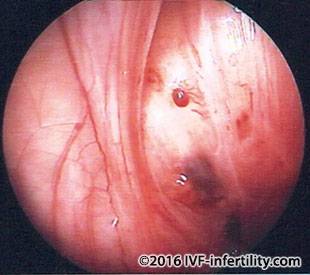
Endometriosis tends to occur in women who are in their 30s and early 40s, but occasionally occurs in those under 30 years of age. Family history of endometriosis is more common in women with the disease.
What are the symptoms of endometriosis?
Endometriosis is a chronic condition. Although some patients with endometriosis have no symptoms (about 20-25%); for many it has severe effects on their physical, mental and social well-being. Some patients may experience considerable pain during their periods (dysmenorrhoea) or deep pain during intercourse (dyspareunia) and their periods tend to be heavy. Some patients may experience pain in the lower abdomen (tummy), pelvis or lower back. Period-related or cyclical bowel symptoms in particular painful bowel movements. Period -related or cyclical urinary symptoms, in particular blood in the urine or pain passing urine.
On vaginal examination their may be tenderness and thickening of the supporting ligaments of the uterus in women with endometriosis. Ovarian cysts may also be felt by the doctor.
The majority of women with endometriosis are fertile. However, some women may experience difficulty becoming pregnant (30 to 50% of patients).
How does endometriosis cause infertility?
The anatomical distortion of the Fallopian tubes and ovaries caused by severe endometriosis as well as deep dyspareunia (painful intercourse) could explain a mechanical cause of infertility. Additionally, it has been reported that women with large endometrioma have reduced ovarian reserve compared with women who had no endometromata. The precise mechanism by which minimal and mild endometriosis affect fertility is not fully understood. It is possible that endometriosis adversely affect the egg development, sperm binding to the egg, fertilization, tubal function and embryo implantation.
How is endometriosis diagnosed?
Endometriosis can be difficult to diagnose with some studies showing a delay in diagnosis of 4-10 years resulting in decreased quality of life and disease progression. The diagnosis of endmetriosis is suspected based on patient symptoms and clinical findings. The only means of diagnosis of endometriosis is by laparoscopy and histological examination of specimens collected during laparoscopy. Laparoscopy assesses the severity of endometriosis and the condition of the Fallopian tubes. There are a number of different classification systems for endometriosis, but the most widely used is that of the American Society for Reproductive medicine (ASRM) in which endometriosis is classified into four stages: minimal, mild, moderate and severe. There is little correlation between the severity of symptoms and extent of the endometriosis. Deep infilterating endometriosis (DIE) where the endometriosis penetrate 5 mm or more under the peritoneum surface into organs such as urinary bladder, ureter and bowel; affect about 20% of women with endometriosis but has the most aggresive presentation.
Ultrasound scans, CT scans, or pelvic MRI scans, can identify cysts on the ovaries, deep endometriosis involving the bowel, bladder or ureter. However, these techniques can not be used to make a definitive diagnosis of endometriosis.
Incidence
The exact incidence of endometriosis is unknown but estimates range from 4-10% among the general female population and 10-50% among infertile patients.
What are the causes of endometriosis?
Cause is unknown. However, the most widely accepted explanation for endometriosis is that during menstruation, viable cells from the lining of the womb pass upwards into the Fallopian tube and out into the pelvic cavity where they settle down. In most women these cells will be destroyed and cleared by the woman's immune system. However, in some women, these cells implant and proliferate, possibly due to a disorder of the womans' immune system.