
Tubal problems
Tubal damage is a common cause of infertility. Damage to the fimbriae may reduce or stop their ability to pick up the egg and direct it into the Fallopian tube. Adhesions around the tube may distort the tube or reduce their mobility, thus affecting their ability to pick up the egg. Damage to the cells lining the tube may prevent sperm from reaching the egg or greatly reduce the chance of fertilization. Blockage of the tube can prevent the sperm from reaching the egg, or the fertilized egg from moving to the uterus and increases the incidence of ectopic pregnancy. Tubal blockage can be either proximal or distal. The former is where the blockage is located close to the uterus, while the latter is where it lies at the fimbriae.
Most women will not be aware of the tubal damage until they have been investigated for infertility. However, some may have severe period pains, irregular or heavy periods, chronic or recurrent pelvic pain and tenderness.
Incidence
15-25%
What are the causes of tubal damage?
Infection
This is the commonest cause of tubal damage. Especially if the infection goes untreated or is treated inadequately at the time e.g.
- Previous pelvic infection such as genital tuberculosis.
- Sexually transmitted diseases such as chlamydia and gonorrhoea.
- Wearing a coil (IUCD) can lead to infection in the womb, which can spread to the tubes.
- Spread of infection from internal organs such as appendicitis, bowel infection.
- After an abortion, miscarriage or delivery, an infection may spread to the tubes.
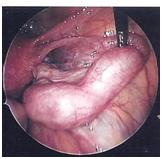
Laparoscopy showing hydrosalpinx
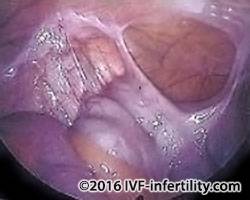
Laparoscopy showing pelvic adhesions
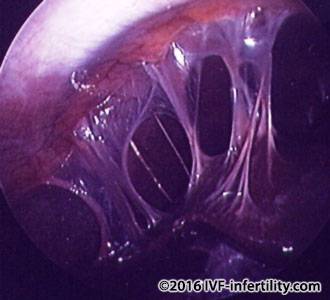
Laparoscopy showing perihepatic adhesions
Surgery
Any surgery that involves the Fallopian tubes, ovaries and uterus can cause adhesions. Sometimes abdominal surgery can also result in adhesions that may affect the tube. Adhesions are bands of scar tissues that binds together organs and tissues. Adhesions are not only caused by surgery but it also caused by inflammation. Most adhesions cause no symptoms or problems but sometimes can cause chronic pelvic or abdominal pain and may cause bowel obstruction. Adhesiolysis is a surgical procedure to free organs, bowels or Fallopian tubes from the scar tissues and can be performed via a key hole surgery (laparoscopy) or through a cut in the abdominal (laparotomy). The outcome of adhesiolysis is usually favourable though adhesions often return.
Previous ectopic pregnancy
Previous ectopic pregnancies can be a cause of tubal damage.
Congenital abnormality
This is an abnormal development before birth such as an absent or maldeveloped tube.
Endometriosis
The condition endometriosis can lead to scarring of the tubes, adhesions, and in severe cases to blockage of the tubes.
Hydrosalpinx
Hydrosalpinx is a blocked, dilated, fluid filled Fallopian tube usually caused by a previous pelvic infection. In mild cases fertility may be restored by opening the tube surgically, otherwise IVF, which bypasses the tubes is the treatment of choice. There is some evidence that hydrosalpinx reduces the success rate of IVF and increases the risk of mscarriage. For this reason, some doctors may advise removing, or occluding the hydrosalpinx before the IVF treatment.