
Multiple pregnancy and multiple birth
In the majority of patients, fewer than 20% of the embryos are implanted after embryo transfer to the uterus, so two or more embryos are usually replaced which results in high-order multiple pregnancies. Data from the USA (SART 2002) concerning multiple pregnancies showed that 32% of deliveries after in-vitro fertilization (IVF) were twins and 7% were triplets or more. In the United Kingdom (HFEA patient's guide 2002), 25% of deliveries after IVF were twins and 1.7% were triplets.
It is important to note that in the United Kingdom, the maximum number of embryos to be replaced per cycle is three. In order to reduce the risk of multiple pregnancy, the HFEA in the United Kingdom has decided to reduce the number of embryos to be transferred from three to two. In exceptional circumstances a three eggs or embryos transfer may be performed. This will be case specific and indications might include clinical and laboratory criteria. Countries have different regulations and restrictions with regard to the number of embryos to be transferred.
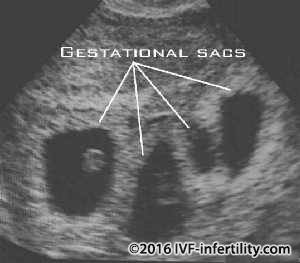
The most important determinant of pregnancy and long-term outcome is whether the pregnancy is a singleton or multiple, irrespective of whether it was a natural or assisted conception. Although the prospect of twin or triplets may seem attractive to some couples, and indeed for the majority of multiples, particularly twins, there is no long-term adverse consequences. high order of multiple pregnancies is associated with increased risks of maternal and fetal complications. In addition, multiple pregnancies place enormous strains for the parents including financial difficulties, emotional distress and physical exhaustion.
As it is impossible to predict who will and who will not have complications perinatal or later in life, elective single embryo transfer in selected groups of women undergoing IVF treatment is warranted.
There has been a significant decrease in the multiple birth rate across all IVF treatemnet types in the United Kingdom since 1991. The multiple birth has decreased from 29% to 11% in 2016 (HFEA report 2018). Similar and even further reduction in the multiple birth rates has been observed in many countries who had adopted single embryo transfer policy.
Previous | Next | Page: 1 2 3 4 5 6 7 8 9 10 11 12 13 14 15 16 17 18 19 20 21 22